I am a Christian, a retired teacher, a mother and a grandmother. I love to read and I love the Lord Jesus Christ! Unless otherwise specified ,all visual illustrations are from the YOU VERSION APP of the Bible.
From the YouVersion Bible App Devotional, “A God Who Is Faithful,” Day 6
Sanctification
Sanctification is simply the process of becoming more like God. Believers become more like him in holiness out of gratitude to God for what he’s done in their lives. The Greek word “sanctify” means “to set apart” for God’s special plans. Paul urged the new believers in Thessalonica to live this kind of life, outlining that it was God’s will for them to walk with Jesus, thus pleasing God with their lives (1Th 4:1,3). He expressed that holy living is very practical and that rejecting the instruction of God brings consequences (v. 8). God has called his people to make daily choices through a different lens: the lens of gospel truth.
When someone puts their faith in Christ, he or she has been sanctified, or “made holy” through the sacrifice of Jesus Christ once and for all (Heb 10:10). Sin is completely wiped away, death is defeated and eternal life is at hand. This is the good news! At the same time, the believer enters into a lifelong process of being purified and becoming more like God through the power of the Holy Spirit (1Th 4:8). [Emphasis added by me] Paul echoes this reality, declaring that God would sanctify the Thessalonians “through and through,” and keep them “blameless at the coming of our Lord Jesus Christ” (1Th 5:23).
Followers of Jesus today can hold on to that promise, for “the one who calls you is faithful, and he will do it” (1Th 5:24).
Today’s Prayer:
Jesus, thank you for the work you are doing in my heart and in my life. Please continue to sanctify me until that day when I join you in paradise. Amen.
My Thoughts
My thoughts are simple this morning. God is still working on me and will continue to work on me to make me holy and like Jesus every day of my life on earth. I am glad that He is patient and full of mercy and He never gives up on me!
From YouVersion Bible App, “The God Who is Faithful, Day 5”
Suffering with Purpose
Paul understood the reality of suffering as well as anyone. His troubles extended to the point that he “despaired of life itself” (v. 8). But Paul recognized that just as believers share in the sufferings of Christ, “comfort abounds through Christ” (v. 5). Knowing this, Paul found joy in his own sufferings and encouraged the believers in Corinth to do the same. Further, Paul recognized that Christ comforts believers in their sufferings so that they, in turn, can bring comfort to others. Paul used his own times of suffering as opportunities to bless those around him. Even when all seemed lost, Paul knew that his suffering occurred so that he would learn to rely less on himself and more fully on God. Having seen Christ work in his own trials in the past, Paul had even greater confidence that God would continue to deliver him so that he might, in turn, continue to minister to the young church.
Just as Paul did, believers today can view struggles and suffering as opportunities to bless those around them. Just as he did not abandon Paul, Jesus will be faithful to his people in all circumstances.
Today’s Prayer:
Jesus, thank you for the growing pains I’ve experienced. Please use me and the experiences from my past to help others. Amen.
My Thoughts
I don’t know about you, but I am not one of those people who say about suffering: “Yes, please sign me up because I know God will be with me.” I am, however, realistic about the fact that we all suffer, to different degrees and at different times, and when we do, God is always there. I do not believe that all suffering happens to teach us a lesson. But I do believe that we can ask God to help us learn from what we go through so that we can help others who go through similar circumstances. I consider myself a realist. We live in the world. It is broken, and as a result of the sin that broke it, we are all suffering until Christ comes again. But we don’t have to suffer with bitterness or anger or even in vain. I truly believe that if we have to suffer, we should sincerely have our eyes open to the opportunities that God will give us to help others later. The One who suffered the most can relate to each of us in our pain and help us through. Then, we in turn, can help others.
From the YouVersion Bible App, “A God Who Is Faithful”, Day 4
A History of Faithfulness
The audience for this psalm is clear: “the descendants of Abraham, his chosen ones, the children of Jacob” (v. 6). The people of God were to hear and heed these words.
The people of Israel seemed to have suffered from spiritual amnesia. So, beginning with Abraham, the psalmist recounted the faithfulness of God over the span of 40 verses. The God of Israel allowed no one to oppress them (vv. 14 – 15). The word of the Lord was fulfilled in the rise of Joseph (vv. 17 – 22). The Lord made his people fruitful, more numerous than their foes (v. 24). When they were enslaved, God sent Moses (v. 26).
While the psalm lists various names, God proves to be the main character. It was God who powerfully delivered them from Pharaoh (vv. 27 – 38). Though this psalm includes only highlights from Israel’s history, the point is clear: nothing God purposed has failed.
The psalmist began with Abraham. Yet, Jesus would assert plainly in the Gospel of John, “Before Abraham was born, I am” (Jn 8:58). The epicenter of God’s faithfulness not only preceded the father of Israel, all God’s promises eventually find their “Yes” in him (2Co 1:20). God remembers his covenant; God’s people remember his wonders (Ps 105:5 – 11).
Today’s Prayer:
Jesus, I don’t ever want to suffer from spiritual amnesia. Help me to always remember everything that you’ve done for me and all that you’ve promised to do. Amen.
My Thoughts
Constantly reminding ourselves of what God has done for us in the past helps us to have hope and faith in the present and the future. Psalm 105 is like a list of things God did for the Israelites, a reminder of His presence and His blessing. Reading the Bible helps me remember, too. I have notes to myself of prayers I have said at particular times with certain verses as parts of my prayer. And I note what I was praying for and recall the answer. I don’t do it often enough, but I also keep a journal of God’s promises made and kept.
I wish we didn’t have to use reminders, that it just came naturally to remember all that God has done for us. But I find that when I am in the pits of despair, I am whining so much that I forget what God has done and will do if I will just let go and listen. In real life, it’s sometimes hard to remember but the devotional today was all about remembering and telling others about what God has done so that they can have their faith built up, too.
From the YouVersion Bible App, “A God Who Is Faithful”, Day 3
Guard the King
Athaliah, whose name means “the Lord is exalted,” did not live up to her name. As the nation unraveled, she continued the murderous pattern of many of the previous pagan leaders. When her son (King Ahaziah) died, she murdered every remaining royal heir and took the throne for herself. But she missed one heir: young Joash, her grandson and the son of Ahaziah. Jehosheba, Ahaziah’s half sister, was married to the high priest and stood in a perfect location to rescue and hide Joash. Athaliah may not have even known of Joash’s existence, which protected him from her rampage. The Lord protected Joash, ensuring that he would inherit the promises God made to David. Once again, David’s royal line endured against all human odds through God’s covenant faithfulness (2Sa 7:16).
In the same way, God protected the infant Jesus from death at the hands of King Herod and allowed him to secure the Davidic throne forever (Mt 2:13 – 20). The entire story of the Bible testifies to God’s faithfulness to fulfill his promises and establish his rule and reign.
Today’s Prayer:
Jesus, I may not always see how the pieces of the puzzle will fit together but help me to always believe that they do. Thank you for your perfect will. Amen.
My Thoughts
I really like the analogy today in the prayer of life being like a puzzle. Sometimes I think I am working out a puzzle in my life that is missing a few pieces, but God knows where all of the pieces are and He is putting it all together for me, in His timing. I don’t like the uncertainty of now knowing what is going to happen next, but I can trust the faithfulness of the God who does know and is working everything out. He protected a young king in order to continue the line of David as He promised. And He warned Joseph to flee with Jesus to Egypt in order to protect Jesus from Herod. God is always working, even when we don’t see it. And He will fulfill His plan for me in spite of all of the obstacles that may pop up. The puzzle of my life isn’t done yet, but I can trust the one who is putting it all together.
From the YouVersion Bible App Devotional, “A God Who Is Faithful”, Day 2
Putting God to the Test
Gideon put God to the test. Gideon, by placing a fleece on the floor, took matters into his own hands and showed that he did not fully trust God. God had already told him that he would fight on the behalf of his people. Gideon’s practice, however, confirmed that he was reluctant to simply take God at his word. The tangible symbol of the wet fleece was a secondary sign of God’s faithfulness to confirm his word to the leader he had chosen. Faced with a far more daunting challenge, Jesus, at the beginning of his earthly ministry, was placed in a situation in which his trust in God’s word was challenged (Mt 4:1 – 11). Satan tempted Jesus to circumvent God’s plan and take matters into his own hands. First, after fasting for forty days, Jesus was challenged to turn stones into bread. Jesus, who would soon multiply a meager amount of fish and bread to feed the multitudes, surely had the ability to turn a stone into a piece of bread. But this action would have amounted to a failure to trust that God the Father, in his time and ways, would supply Jesus’ needs. Second, Satan tempted Jesus to throw himself off the highest point of the temple, citing that angels would protect him. This temptation would have bypassed the God-ordained path for his life, death and victorious resurrection. Third, the King of the universe was tempted to doubt God’s word and procure his own path to power and glory.
At each juncture, Jesus refused to test God’s word and faithfulness. Instead, relying on the power of God’s promises, he rejected Satan and continued to walk in confidence that God would provide. Throughout Jesus’ earthly ministry, religious leaders continued to place tests before Jesus in an effort to discount his claims to being the Son of God (Mt 16:1; Mk 10:2). Jesus refused to cater to their demands, while indicating that his public words and deeds were more than enough to show them who he was.
God’s Word and his proven faithfulness are a strong foundation for the faith of his people today. Met with the challenges of life in a fallen world, the church need not test God with trivial exercises like Gideon did here. God’s people, following the pattern set by Jesus, can stand securely on his Word and his character even in an uncertain future.
Today’s Prayer:
Jesus, I don’t want to doubt you like Gideon did. Help me to always take you at your word, because I know that your word never fails. Thank you for your miraculous power and your perfect timing. Amen.
My Thoughts
As I read today’s devotional, I could almost hear God’s exasperated sigh as Gideon asked for signs that He was truly calling him to lead. But God was patient and provided the signs Gideon needed to have confidence in the ability that God had given him. It made me think of all the times that I have not stepped out when I heard God tell me to do so because I lacked confidence. I’m not sure I was waiting to a sign, but I was definitely waiting for a push or a shove from God. I think God wants me to have confidence in Him just because He is God and has proven Himself over and over with me.
When I read Jesus’s responses to Satan, I can visualize Jesus calmly saying them to His enemy and then going back to talking to His Father. I know myself well and at that point of the temptation by Satan, I would have been stomping my feet and loudly yelling, hoping he would go away. But calm and quiet is the way of the Lord, not angrily demanding my rights as a Christian. I have no rights except what God has given me, so leaning on Him also means being patient and remaining peaceful.
I understand why people like Gideon wanted to test God. To me, it was a lack of self-confidence but it was also a lack of knowledge of just who God is and all of His power over His creation. In other words, I think it shows a lack of trust. So, why is the story of Gideon included in the Bible? Well, first of all, because God wanted it there. We can only speculate about why and perhaps shouldn’t go there. But I like to think that God included it because He wants us to know that it’s okay to not be fully confident in our own abilities because He has enough for each of us to make up for our shortcomings. If we have difficulty trusting, I think God is much more pleased when we are honest with Him about it than when we hide the truth from ourselves and don’t do what He wants us to do.
Satan questioned Jesus. The Pharisees questioned Jesus. The Sadducees questioned Jesus. And He answered all of them the same way, quietly reminding them of God’s Word. May we all learn to trust the way Jesus did and to answer with the Word of our Father, sending our enemies away puzzled by our reply and perhaps wanting to know more about the God we serve.
The Silent Patient meets Rebecca in this twisty debut about the mysterious death of a woman with congenital analgesia, a rare condition where she can’t feel any pain – and an obsessive journalist who will stop at nothing to uncover her most dangerous secrets. Meet Eva, who can’t feel pain, and Anna, who can’t escape it. Everyone has heard about the case of Eva Reid. Ever since she was born, she’s been immune to physical pain – she can get a paper cut, break a limb, and even give birth without feeling a single thing. Her rare condition has long-captivated reporters and researchers – including Dr. Nate Reid, Eva’s husband and acclaimed scientist renowned for his work in The Pain Laboratory. Also among them is Anna Tate, a ruthless journalist with a dark past of her own. When Eva is suddenly found dead inside her home, it raises a flurry of questions around the last night of her life – and who might’ve been involved. Anna finds herself growing increasingly obsessed with Eva’s case: her cloistered, painless existence, her promising career as a psychotherapist, and especially her toxic relationship to Dr. Reid, whom she met and married as his former patient. But what other secrets could they be hiding?
When Dr. Reid embarks on the process of writing a book about Eva, Anna makes sure she’s first in line to work on the project with him. As she slowly inserts herself into their home and seeks to uncover what’s fact and what’s fiction, shocking discoveries await her – and not everyone may come out unscathed…
My Thoughts
What a chillingly delightful novel! The woman married to the pain specialist, Eva, is found dead under some rather mysterious circumstances. But what a complication! She cannot feel pain since she suffers from a congenital condition that precludes her from doing so. When Anna, a ghostwriter, enters the scenario, she is fascinated with Eva’s story and Dr. Reid’s obsession with studying pain. Anna is determined to find out what really happened the night that Eva died, but her quest is filled with some unexpected twists and turns as well as danger. This is a moderately paced novel, perfectly paced for the action in the story. The characters are compelling and dynamic and the research that is included in the story is absolutely riveting. I had trouble putting down the book, especially once Anna started her independent investigation. This book proves that one should not take anything for granted and that not all narrators can be trusted. With a web of deceit built into the story as well as a cleverly executed page-turner with some head-spinning twists, this novel captivated my attention and intrigued me with its profound revelations about pain and how it can be manipulated. Edgy and satisfying novel that is terrifyingly brilliant! Disclaimer Disclosure of Material Connection: I received a complimentary copy of this book from the publisher via Netgalley. I was not required to write a positive review, and all opinions expressed are my own. I am disclosing this in accordance with the Federal Trade Commission’s 16th CFR, Part 255, “Guidelines Concerning the Use of Testimonials and Endorsements in Advertising.”
Note that this is contemporary fiction and I rate it PG-15
About the Author
Emma Cook has been an editor at the Guardian for 16 years, commissioning on Guardian Weekend, editing her own section Do Something and now assistant editor and travel editor on the Observer magazine. She has written for a range of titles including the Guardian, the Independent, the Times, the Daily Telegraph, ES Magazine, Elle and Psychologies. She is an alumna of the Faber Academy’s six-month Writing A Novel course, and You Can’t Hurt Me is her debut novel.
From the YouVersion Bible App Devotional, “A God Who Is Faithful”, Day 1
A Faithful God and an Unfaithful People
The book of Judges presents a stark contrast between the faithfulness of God and the unfaithfulness of his people. It is astounding to consider that so soon after their miraculous deliverance from Egypt, a generation arrived on the scene that neither knew the Lord nor the works that he had done for them. The very same nation who was an eyewitness to the stunning might of God had now forgotten him altogether. Their forgetfulness is seen in their ever-increasing propensity toward rebellion.
One would anticipate that their sin would prompt God to abandon his people forever. Yet, time and time again, an avalanche of God’s grace meets the faithlessness of the people. In fact, the text records God’s pity on the people and his attentiveness to their cries. Previously, Moses recounted how the people of God groaned because of their slavery and cried out to the Lord (Ex 2:23 – 25). These cries for deliverance were met by responses from the Lord. He heard their cries. He remembered the promises he had made in his covenant with them. He saw their need, and he knew their pain. This is the nature of the faithfulness of God — he hears, remembers, sees and knows.
Now, generations later, God heard the cries of his people and provided judges to lead them to victory. He did this despite the fact that they had demonstrated a perpetual inability to obey, even for a generation. God’s faithfulness is clearly not predicated on the goodness of his people. Rather, God’s faithfulness is founded on his character. He is a faithful God who always keeps his promises.
The faithfulness of God is the hope on which the Christian life is built. Those who know Jesus through repentance and faith can rest assured that God is faithful to his promises (1Co 1:9). He will not abandon his people, nor will he turn his back on them when they are unfaithful. Instead he hears, remembers, sees and knows. (Emphasis added by me) He hears the cry for mercy from those who know they are broken. He remembers his covenant, made long ago to Abraham, to save his people. He knows the needs of his people and, by virtue of Christ’s work, has made provision to meet those needs and restore them to a right relationship with him forever.
Today’s Prayer:
Jesus, I thank you and praise you for your grace and faithfulness. Thank you for never giving up on me, even when I am ungrateful, rebellious and forgetful of your goodness. Amen.
My Thoughts
I have never been in slavery, captive by people who use me mercilessly. But I have been in slavery to sin, and God has freed me, not because of anything I have done but only because of His mercy and grace.
It is reassuring to know that God remains faithful even when we lose sight of the pathway He has us on and wander away. He is faithful to get us back on the right pathway and get us headed again in the right direction. God knows that we are human with all of the weaknesses and temptations that come along with it, and the good news is that He loves us anyway and is always faithful. He hears when we cry out to Him. I have a regular routine of praying daily, but that was not always the case. Even if I went days without acknowledging God (confession here: I am guilty of having done this in the past and know that I can fall into that pattern in the future if I allow myself to do so), once I called on the Name of the Lord, I felt Him draw near to me, ready to hear and answer my call. Why would He do that? Why would He be so faithful when I, and other humans, have a tendency to turn towards self-sufficiency instead of toward Him? Then the going gets rough and we turn to God. I have learned a big life lesson to always call on God, every day, no matter how I expect my day to go or what is going on in my life.
Having said all of this, I have a prayer request for a dear friend in PA. She was diagnosed with tongue cancer. No, she never smoked or used tobacco products, ever! That was last year. Now, it has progressed and she is on hospice care. We share a love of good Christian books and I have sent her some of my favorites via my daughter who attends her church. In fact, she taught all of my grandchildren there at one time or another. Please pray for Millie and her family. She has two sisters, one a twin, and I am sure that the knowledge that she only has a few months to live is devastating to them. I know it is breaking my heart; she is such a kind, sweet lady. I won’t tell you how to pray, but I am asking you to pray. God is faithful!
From YouVersion Bible App Devotional, “Reconnected”
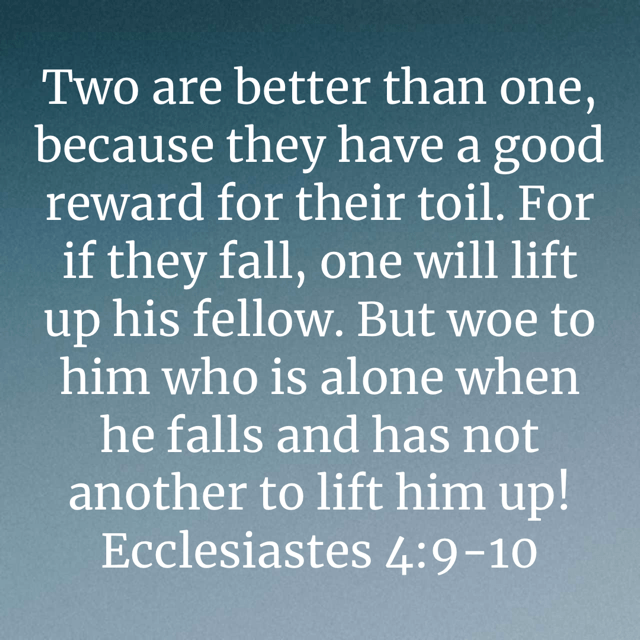
Day 5: Community
I talk to a lot of very connected people—people who, from a distance, look like they have more friends than they know what to do with. But most of them tell me they are actually lonely and wish they had more friends. We are the most digitally connected generation in the history of planet Earth and it would not be a stretch to say that we are also the loneliest.
Watching groups of friends choose to stare at their phones rather than engaging with each other when they are together is, if you think about it, insane. If you had beamed into our current reality from 1980 and saw friends doing that, you would think they were avoiding each other because they didn’t want to be together. This is a problem.
The Amish will never have this problem because they won’t allow themselves to. They aren’t anti-technology; they are pro-community. So they weigh the potential value of every piece of new technology before allowing it.
We don’t have to give up technology to have community, but we can be more intentional about the limits we place on technology that may be hindering us in finding true community. [Emphasis added by me] If you don’t have a thriving community where you live, I have good news—you can find one. If you do have a thriving community, I have good news for you too—you can make it better.
Prayer
Lord, please give me guidance and wisdom as I seek to have community with those around me, and please help me wisely place limits on the technology I allow to come into my life. Amen.
My Thoughts
One of my pet peeves is going into a restaurant and looking around at all of the people having a meal together, but they aren’t really together. They each have a device in their hands and are communicating with online friends, or maybe even strangers, instead of those sitting with them. I like the restaurants that have a “no cell phone” rule during meals rule. They are few and far between, but I think it’s a great idea since people won’t govern themselves.
Our lives on earth are so brief; the Bible says it’s a vapor, a vanishing mist. And yet we while away the hours we have on devices that have no emotions and no real connection to us. I understand that technology has some good uses, like being able to communicate via a blog or a text message. But, for the most part, I think technology controls parts of our lives that need to be tuned into people and not an inanimate object.
When my husband and I go out to eat, rare in these days of tight finances, we each put our phones away and talk to each other. It’s not important what we say, as long as we are taking the time to look at each other and really talk. If we had our phones on the table as so many do, that would be a distraction to having our attention focused on each other as it should be.
I am sad for the current generation of young people because their parents are showing them by example that it’s okay to make the device a priority instead of the people around you. I like what the author said about the Amish. They wisely choose what technology to allow into their community, not just accepting all of it as “progress” and “good.” We would do well to follow their example.
















 Vickie's Book Nook and Meditation Corner