I am a Christian, a retired teacher, a mother and a grandmother. I love to read and I love the Lord Jesus Christ! Unless otherwise specified ,all visual illustrations are from the YOU VERSION APP of the Bible.
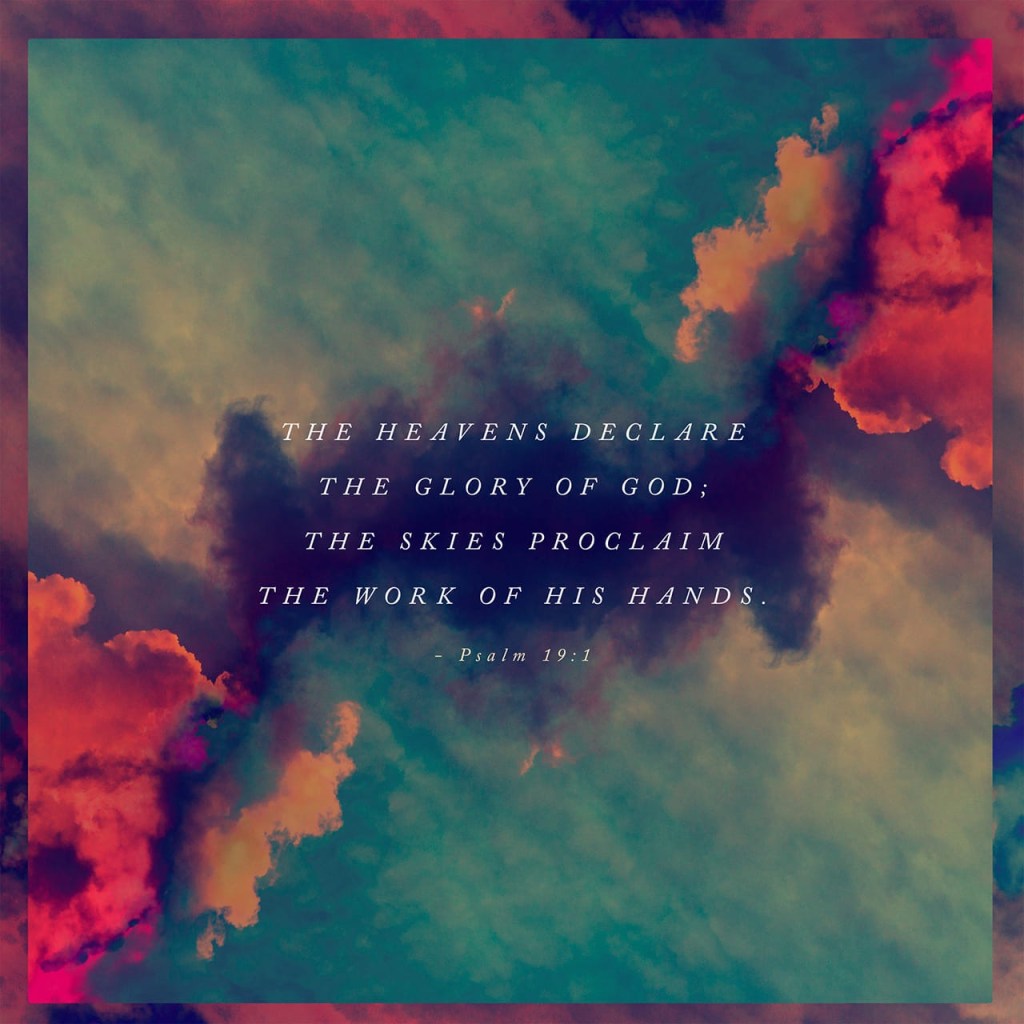
God created. I believe and accept His gracious gifts that He has given us. I appreciate all that is around me, all that shows me God’s love and creativity.
The waves at Myrtle Beach, SC. Aren’t they gorgeous and powerful? The Bible says that God made these waves, separating the sky from the waters on earth and set the limits that the waves can go, this creating the beaches.
God created all of the trees and all of the plants that we use for food. He also created breathtaking flowers like this rose in my garden that blooms every spring and every fall.
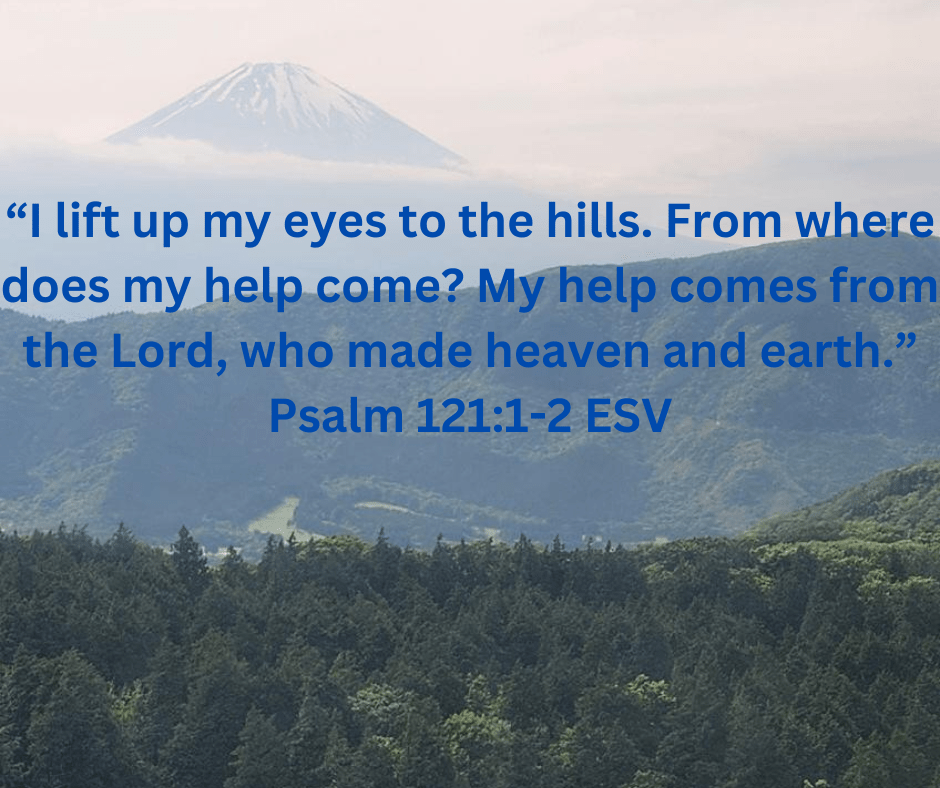
I created this on Canva from a photo that our grandson sent us of Mount Fuji in Japan. God made the mountains, the valleys, all of the landforms that we enjoy. I really enjoy the mountains since I grew up in the foothills of the Blue Ridge.
And, finally, I appreciate that God made me and all of my family. The top photo is me and my husband on our 50th wedding anniversary. The middle photo is our children when they were very young. The bottom row includes our daughter’s five children, our son and his son, our son and his daughter, and our youngest son and his family. We are blessed indeed.
When I was growing up, during my teen years, I remember multiple times asking my mother if I could do something that all of the other kids were doing, like stay out all night with a group of boys and girls. The answer was always “no” because my mom said it wasn’t “proper.” My argument would be that everyone else was doing it. And my mom’s reply was always, “If everyone else goes ahead and jumps off a bridge into a rocky water, are you going to be foolish and do the same thing?” I didn’t think at the time that made much sense, but with many years and raising my own three children behind me, I finally understood what she was saying.
God basically tells us the same thing in His Word. He took us out of Egypt, which represents sin, so why do we keep wanting to go back there? The answer is the same as what I gave my mom: everyone else is doing it. It seems that the whole world minus the practicing Christians have decided that wrong is right and right is wrong. You can be any gender you want, you can have sexual relationships with anyone you want at anytime whether you are married or not, and you can generally do anything that makes you feel good. That is what the world teaches. But it isn’t what God says.
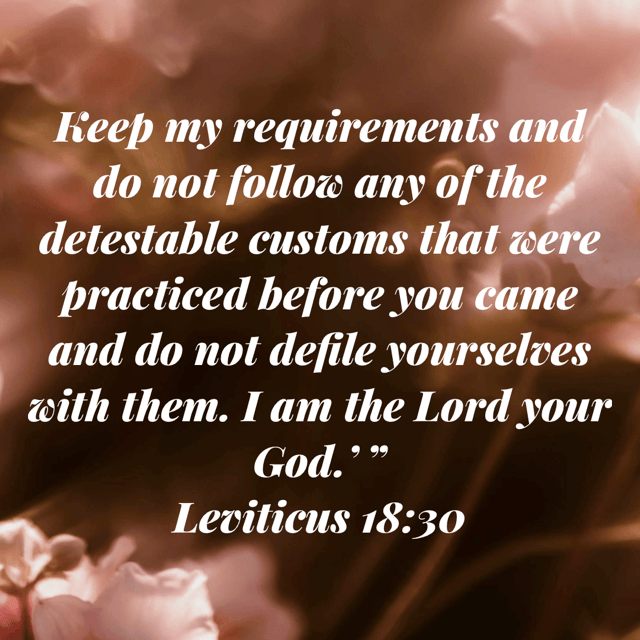
“You must not do” is a strong admonition to not choose to sin. The land of sin that we left behind when we chose to follow God didn’t disappear. It is still there, enticing us to join in and enjoy all of the pleasures of sexual immorality and idolatry that the world has to offer. But God says “no.”
This scripture verse is spoken to the Israelites, but God also calls His chosen people to be holy. We are to be set apart, to be different rather than joining in on the destruction of our own souls.
God repeats His admonition to be holy in the New Testament, just in case we are deceived into thinking that the Old Testament regulations don’t apply to us. God didn’t say to “try” to be holy. He said to BE HOLY. This is a daily choice we make to walk away from sin, even if everyone else seems to be doing it.
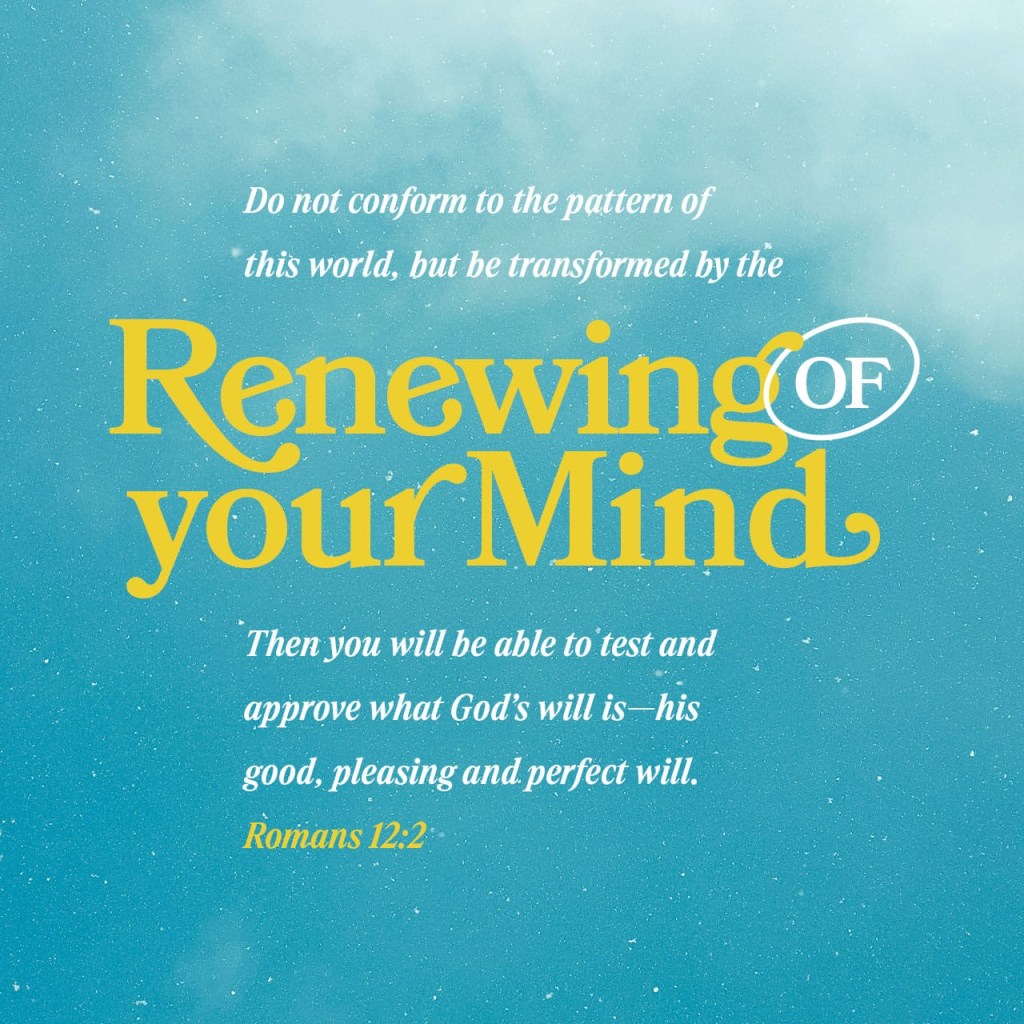
How are we able to walk away in the face of constantly being bombarded with temptation? It takes a daily renewal of our mind through God’s Word and spending time with Him. How much time do we spend filling our mind with garbage from the internet and from our televisions and radios? Turning them off and focusing on God is what will help to renew our mind. Remember the adage: GIGO (garbage in, garbage out). The temptation to sin is everywhere so we have to turn away and focus on what God says, not what the world says is acceptable.
So, what is the reward for turning away from sin and walking with God? We are blessed. If we walk with the sinners, we will sin. If we keep company with those who mock God and our faith, we will be more and more tempted not to stand firm because the natural human tendency is to want to fit in. It’s a hard word, but we are to be separated from the world and its enticement to sin, not align ourselves with it. But, you say, we need to witness, to be ambassadors for Christ. That is absolutely correct! But do you recall one instance in which Jesus sinned? Of course not! He never chose to sin; He admonished others to “go and sin no more” but not once did He ever join in with their debauchery or sinful behavior. He made the same choice we have to make. We are in the world, sharing His Word with others, but we don’t join the world in making sinful choices.
God is our Lord and we have to choose to act like He is our Sovereign King in every choice that we make. The customs of today’s world are detestable and despicable, an affront to our Creator. We cannot in good conscience join in on the sinful revelry and not expect to suffer consequences and a distance from God. God doesn’t move away from us, so we should never choose to move away from Him.
If you want to have a relationship with our Creator, it is imperative that you spend time with Him. One of the best ways to do that is to spend time reading and studying His Word. That is where you find out about His love and His promises to each of us. It is hard for us finite beings to conceive of an infinite God, One who is not restrained by time and who set the whole world into motion. In reading His Word, we get a small understanding of who He is, more and more each day we spend time with Him. He shows us who He is, what His plan for the world is, and what His purpose for us is, all through His Word.
When you sign a contract, you think that it will all be carried out. But sometimes, that just doesn’t happen. Marriage comes to mind. Most of us enter into marriage with the idea that it is for life. Then, problems come up and one or both of you decide to “void the contract” and start a new life without that other person. I have never suffered that break in a contract, but I have had numerous friends and family members who have. Divorce is not an easy thing to go through because promises were made and then somehow broken. Sometimes our experiences in life keep us from wanting to have a close relationship with God because we don’t really trust someone we can’t see. After all, those we see are constantly disappointing us.
God is different in a way that is almost impossible to describe because each individual has to have a personal relationship with Him in order to get to know Him. And you cannot get to know Him without starting with faith and a belief that He will do just as He has said in His Word. The ironic thing is that you won’t know what is in His Word unless you read and study it. So, we have come full circle. Why read God’s Word? The short answer is to know Him. The real answer is to know who you are meant to be in relationship with Him. We were never meant to travel this world with unfurled sails and without a rudder or compass. God provides both in His Word, both the power and the direction we need to go. I hope that if you have not started already, you will begin a daily journey of getting to know the One who knows you best and loves you most. Just pick up a Bible and read God’s love story to you. I recommend that you start with the Book of John. Find a Bible plan online and stick to it. Get together with a friend or a group of friends to discuss what you have discovered about God each week. Establish a firm foundation with the One whose word never fails.
“A fast-paced and vibrant wartime tale of holding on to love against the odds and learning to fight for the truth.” –Kristin Harmel, New York Times bestselling author of The Paris Daughter
A Parisian department store, a mysterious necklace and a woman’s quest to unlock a decade-old mystery are at the center of this riveting novel of love and survival, from New York Times bestselling author Pam Jenoff
London, 1953. Louise is still adjusting to her postwar role as a housewife when she discovers a necklace in a box at a secondhand shop. The box is marked with the name of a department store in Paris, and she is certain she has seen the necklace before worked with the Red Cross in Nazi-occupied Europe —and that it holds the key to the mysterious death of her friend Franny during the war.
Following the trail of clues to Paris, Louise seeks help from her former boss Ian, with whom she shares a romantic history. The necklace leads them to discover the dark history of Lévitan—a once-glamorous department store that served as a Nazi prison, and Helaine, a woman who was imprisoned there, torn apart from her husband when the Germans invaded France.
Louise races to find the connection between the necklace, the department store and Franny’s death. But nothing is as it seems, and there are forces determined to keep the truth buried forever. Inspired by the true story of Lévitan, Last Twilight in Paris is both a gripping mystery and an unforgettable story about sacrifice, resistance and the power of love to transcend in even the darkest hours.
My Thoughts
This historical fiction novel includes a multi-layered plot, mesmerizing and realistic characters, dual timelines and two different points of view. The timelines are close together, in the 40’s during the war and in the 50’s following the war and I found this a unique perspective from most historical fiction. One narrator is Helaine, a Jew in Paris who is captured and forced to work in a former upscale department store. There she has to sort and sell things that the Nazis have confiscated from the Jewish people they have sent to prison camps. The second narrator is Louise, a housewife in London who finds a necklace that she saw on the day a good friend died during the war. Louise is determined to go on a quest to find the other half of the necklace and to find out what really happened the night that Franny died. There are a lot of characters, a great deal of history and a completely absorbing plot as Louise follows the clues to a resolution and Helaine’s story of forced labor and being away from her beloved husband are told. I enjoyed the details of the story, especially the way the layers dovetailed together seamlessly at the conclusion. I also liked meeting the characters who were realistically flawed, with love lives that were not perfect and their dreams that they tried to fulfill. This is a timeless story of persistence, friendship, loyalty and tragedy that is memorable and a great book for discussion. Disclaimer Disclosure of Material Connection: I received a complimentary copy of this book from the publisher via Netgalley. I was not required to write a positive review, and all opinions expressed are my own. (Federal Trade Commission’s 16th CFR, Part 255, “Guidelines Concerning the Use of Testimonials and Endorsements in Advertising.”)
Historical Fiction with content about treatment of war prisoners, Rated PG
About the Author
Pam Jenoff is the author of several books of historical fiction, including the NYT bestseller The Orphan’s Tale. She holds a degree in international affairs from George Washington University and a degree in history from Cambridge, and she received her JD from UPenn. Her novels are inspired by her experiences working at the Pentagon and as a diplomat for the State Department handling Holocaust issues in Poland. She lives with her husband and 3 children near Philadelphia, where she teaches law.
Helaine stumbled forward, unable to see through the black void that surrounded her. She could feel the shoulders of the others jostling on either side. The smell of unwashed bodies rose, mingling with Helaine’s own. Her hand brushed against a rough wall, scraping her knuckles. Someone ahead tripped and yelped.
Hours earlier, when Helaine had been brought from her underground cell at the police station into the adjacent holding area, she was surprised to see other women waiting. She had not encountered anyone since her arrest. She had studied the women, who looked to be from all walks of life, trying to discern some commonality among their varied ages and classes that had caused them to be here. There was only one: they were Jews. The yellow star they wore, whether soiled and crudely sewn onto a worn, secondhand dress or pressed crisply against the latest Parisian finery, was identical—and it made them all the same.
They had stood in the bare holding area, not daring to speak. Helaine was certain that her arrest had been some sort of mis take. She had done nothing wrong. They had to free her. But even as she thought this, she knew that the old world of being a French citizen with rights was long gone.
An hour passed, then two. There was nowhere to sit, and a few people dropped to the floor. An elderly woman dozed against the wall, mouth agape. But for the slight rise and fall of her chest, she might have been dead. Hunger gnawed at Helaine and she wished that she still had the baked goods she purchased at the market just before she was taken. The meager breads, which had seemed so pathetic days earlier, now would have been a feast. But her belongings had been confiscated at arrest.
Helaine looked upward through the thin slit of window near the ceiling. They were still in Paris. The sour smell from the city street and the sounds of cars and footsteps despite the curfew were familiar, if not comforting. How long they would stay here, she did not know. Helaine was torn. She did not want to remain in this empty room forever. Yet she also dreaded leaving, for wherever they were going would surely be worse.
Finally, the door had opened. “Sortir!” a voice ordered them out in native French, reminding Helaine that the policemen, who had brought them here and who were keeping them captive, were not Germans, but their own people.
Helaine had filed into the dimly lit corridor with the others. They exited the police station and stepped outside onto the pavement. At the sight of the familiar buildings and the street leading away from the station, Helaine momentarily considered fleeing. She had no idea, though, where she would go. She imagined running to her childhood home, debated whether her estranged mother would take her in or turn her away. But the women were heavily guarded and there was no real possibility of escape. Instead, Helaine breathed the fresh air in great gulps, sensing that she might not be in the open again for quite some time.
The women were herded up a ramp toward an awaiting truck. Helaine recoiled. They were being placed in the back part of the vehicle where goods should have been carried, not people. Helaine wanted to protest but did not dare. Smells of stale grain and rotting meat, the truck’s previous cargo, assaulted her nose, mixing with her own stench in the warm air. It had been three days since she had bathed or changed and her dress was wrinkled and filthy, her once-luminous black curls dull and matted against her head.
When the women were all inside the truck, the back hatch shut with an ominous click. “Where are they taking us?” someone whispered. Silence. No one knew and they were all too afraid to venture a guess. They had heard the stories of the trains headed east to awful places from which no one ever returned. Helaine wondered how long the journey would be.
As they bumped along the Paris streets, Helaine’s bones, already sore from sleeping on the hard prison cell floor, cried out in pain. Her mouth was dry and her stomach empty. She wanted water and a meal, a hot bath. She wanted home.
If home was a place that even existed anymore. Helaine’s husband, Gabriel, was missing in Germany, his fate unknown. She had scarcely spoken with her parents since before the war. And Helaine herself had been taken without notice. Nobody knew that she had been arrested or had any idea where she had gone. It was as if she simply no longer existed.
To distract herself, Helaine tried to picture the route they were taking outside the windowless truck, down the boulevards she had just days earlier walked freely, past the cafés and shops. The familiar locations should have been some small comfort. But this might well be the last time she ever came this way, Helaine realized, and the thought only worsened her despair.
Several minutes later, the truck stopped with a screech. They were at a train station, Helaine guessed. The back hatch to the truck opened and the women peered out into pitch blackness. “Raus!” a voice commanded. That they were under the watch of Germans now seemed to confirm Helaine’s worst fears about where they were headed. “Schnell!” Someone let out a cry, a mix of the anguish and uncertainty they all felt.
The women clambered from the truck and Helaine stumbled, banging her knee and yelping. “Quiet,” a woman’s voice beside her cautioned fearfully. A hand reached out and helped her down the ramp with an unexpectedly gentle touch.
Outside the truck it was the tiniest bit lighter, and Helaine was just able to make out some sort of loading dock. The group moved forward into a large building.
Now Helaine found herself in complete darkness once more. This was how she had come to be in an unfamiliar building, shuffling forward blindly with a group of women she did not know, uncertain of where they were going or the fate that might befall them. She could see nothing, only feel the fear and confusion in the air around her. They seemed to be in some sort of corridor, pressed even more closely together than they had been. Helaine put her hand on the shoulder of the woman in front of her, trying hard not to fall again.
They were herded roughly through a doorway, into a room that was also unlit. No one moved or spoke. Helaine had heard rumors of mass executions, groups of people gassed or simply shot. The Germans might do that to them now. Her skin prickled. She thought of those she loved most, Gabriel and, despite everything that had happened, her parents. Helaine wanted their faces, not fear, to be her final thought.
Bright lights turned on suddenly, illuminating the space around them. “Mon Dieu!” someone behind her exclaimed softly. Helaine blinked her eyes, scarcely daring to believe what she saw. They were not in a camp or a prison at all. Instead, they were standing in the main showroom of what had once been one of the grandest department stores in Paris.
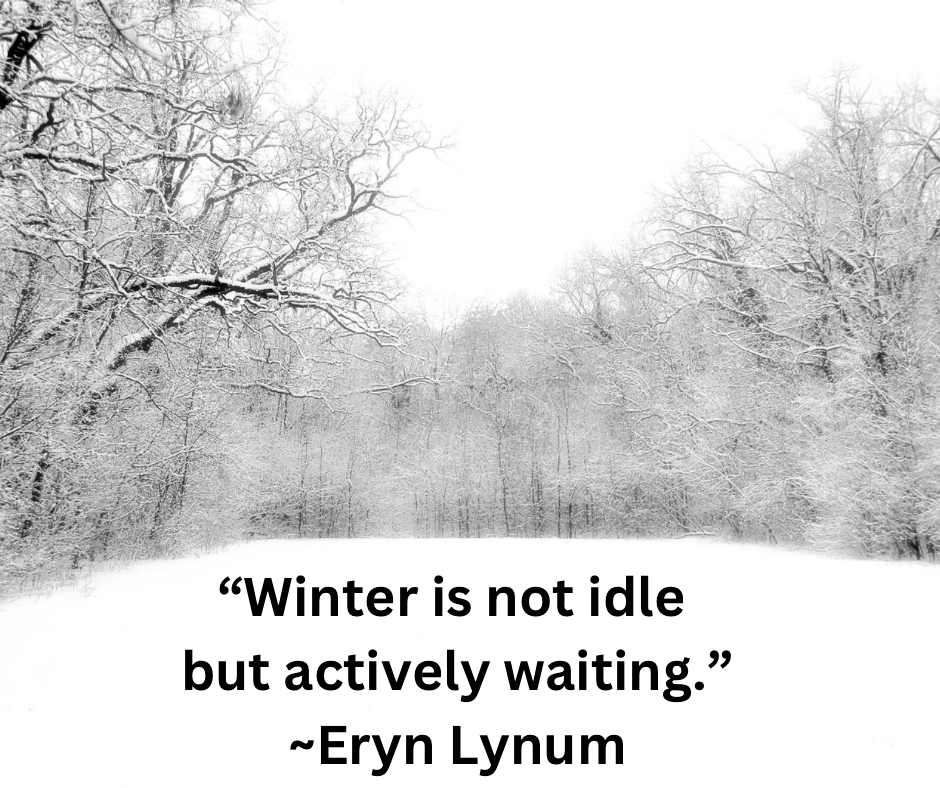
I learned a new word in my devotional this morning. It is “qavah” and the definition according to the online Hebrew dictionary is “To wait, to look for, to hope, to expect.” (https://biblehub.com/hebrew/6960.htm) Isn’t that a perfect word for what happens in winter? Everything looks dead, standing or lying around in a state of dormancy while actually waiting for new life in the spring.
I think that is what we are supposed to do all the time. We may not actually be busy doing a lot, but we should all be actively waiting for the return of our Savior, the One who brings Resurrection life to all who believe in Him. Meanwhile, we need to listen for God to give us our marching orders for what to do while we wait. Just as the trees and flowering bushes know what they are supposed to do as they wait for spring, we know, too. We are to serve the Lord with gladness, come before His presence with singing and tell all the world about Him.
God is keeping us safe, even when the days are long and the ice and snow continue to fall. Imagine being enfolded into His arms and told to just wait for spring…good things are coming! Yesterday, I asked God specifically to show me someone with whom I could share His love. God, who never does things halfway, prompted me to share with my arthritis doctor that I may not be able to move well on earth, but one day I will be running in Heaven. He looked at me askance and rolled his eyes, but I think I planted a seed. Then my husband and I stopped at the Dollar Store to get cards and a few snacks. I checked out and rolled the buggy outside to unload. That is when I found an item in the bottom of the buggy that I forgot to unload at the register and pay for. So, I grabbed in, walked back in and apologetically told the clerk what had happened. She couldn’t believe that I would return to pay for something that she didn’t even notice I had. She informed me with a smile that I could have just taken it and no one would have noticed. So I told her, “But my God wouldn’t have liked that.” Her eyes got big and she replied that was a different thing to do, to come back and pay. So, another seed planted And these seeds were planted in winter!
It is not in my nature to be a patient in waiting. But good things take time, and God’s plans are the best ones. So, waiting it is, through the winter in which all looks dead. But God and I (and you, too) know that life all around us is not dead. It is sleeping and preparing for a wonderful spring! God made all of the seasons on earth and they have a purpose. We can learn from them, can’t we?
Sometimes it is hard to be a good witness to others. I get really frustrated and tired at times. I think the reason is that I have to spend more time with God and ask Him to help me to see other people the way He sees them.
Moses and Aaron were the leaders of the Israelites, appointed by God to lead them away from Egypt. Before they went before the people that they were leading, they had to first go before God themselves. Once they did the preparation, they were ready to tackle the task and God showed His approval by sending His glory before all of them.
I am no Moses or Aaron, but if I am going to be an effective minister to others, in any capacity, I have to first appear before God myself. I need to spend time in prayer and worship and in His Word. My time with God needs to be quality time, not just to “get it done” and move on to the next thing. I know that God is there with me, but when I leave my prayer chair, I want to know that He goes with me so that what I speak and what I do is pleasing to Him. I am aware that I often disappoint the Lord because I miss opportunities that He has given me to serve and to say. I don’t want that to be the pattern of my life. Rather, I want the pattern to be one of taking what I get from God to others who need Him as much as I do.
If all I do is go into God’s presence and I never come out in to the world to serve, I am not fulfilling His plan for me in the world that He created. So, my prayer is that I can be a faithful servant who goes in with God and comes out with Him, too, ready to share and to be His ambassador to a hurting world.
To escape the Nazis, she must become a spy. To save the Allied cause, must he betray his heart?
The only way Cilla van der Zee can survive the German occupation of the Netherlands is to do the unthinkable–become a spy for the Nazis in Britain. She soothes her conscience with a plan to abandon her mission and instead aid the Allies. Her scheme is thwarted when naval officer Lt. Lachlan Mackenzie finds her along the Scottish shore and turns her in to be executed.
But perhaps she is more useful alive than dead. British intelligence sends her to Scotland to radio misleading messages to Germany, messages about the naval base at Scapa Flow to be crafted by Lachlan. At the station in the lighthouse at Dunnet Head, Lachlan and Cilla must work together if the war is to be won. But how can he trust a woman who arrived on his shores as a tool of the enemy–a woman certain to betray both him and the Allied cause?
My Thoughts
The latest historical fiction novel by Sarah Sundin takes the readers to the Scottish shore during WWII. The story is fascinating, with meticulous details about the part Scotland played in the war as well as about several actual historical figures written into the plot. Cilla Van der Zee is a citizen from the Netherlands who plans to escape the Nazi oppression there by pretending to be a spy for them and by taking a U-boat to the Scottish shore. Unfortunately, she is apprehended by Lachlan, a young naval officer there, and then Cilla is forced to become a double agent instead of going to live with her aunt as was her original plan. The legend of the selkie which is woven into the story was completely engrossing. This novel was addictive and unputdownable, keeping me up late into the night since I was engrossed by the nail-biting suspense and the escalating tension as Cilla faces prison time or worse. The developing romance between Lachlan and Cilla is warm and believable, told with humorous banter between the two who start out as enemies and slowly become friends. The plot is deeply immersive, with historical details that enrich the story with their authenticity and made me want to know more, which the author nicely provided in an afterword that added to my enjoyment of the story. The author infuses the entire story with spiritual truths that include forgiveness, mercy, grace and compassion. I really liked the sibling rivalry between Neil and Lachlan that formed an intriguing sub-plot as well as the cameo appearances of characters from a previous book. This book is a compelling read that was brilliantly written with a strong message of fortitude, clever plot twists and a remarkable attention to realism. I learned a lot about Scotland as I read and grew to appreciate the landscape, the use of lighthouses and the heroism of local people who just wanted to protect their homeland. Disclaimer I received a complimentary copy of this book from the publisher via Netgalley. I was not required to write a positive review, and all opinions expressed are my own. (Federal Trade Commission’s 16th CFR, Part 255, “Guidelines Concerning the Use of Testimonials and Endorsements in Advertising.”)
Historical Fiction, Christian novel, Rated PG due to war scenes
Sarah Sundin is the bestselling author of Embers in the London Sky, The Sound of Light, Until Leaves Fall in Paris, and When Twilight Breaks, as well as the popular WWII series Sunrise at Normandy, among others. She is a Christy Award winner and a Carol Award winner, and her novels have received starred reviews from Booklist, Library Journal, and Publishers Weekly. Sarah lives in Southern California. Visit SarahSundin.com for more information.
Do you remember when you first became a Christian and there was a fire kindled in your soul to tell others all about your new relationship with Jesus? God started that fire burning, and the Holy Spirit helps us to keep putting wood on the fire, but we have to participate actively in keeping the fire in our soul going.
When the Israelites offered sacrifices on the altar in the tabernacle, God established that there would be certain priests who would be in charge of keeping the fire on the altar burning.
We each have an altar to God inside our hearts that we are each responsible for and should not be letting that fire go out. How do we do that?
Jesus was our living sacrifice to the Father and we are each a living sacrifice to Him. Our lives and the way we live them keep that fire burning in a way that pleases God.
Adding Wood to the Fire
There are some steps we can take to make sure our fire never burns out.
~Read and study God’s Word daily. Have an established place to do this and a time that works for you. Your routine may have to be adjusted occasionally due to other commitments, but make sure that time with God is your priority time, not the leftovers at the end of a busy day.
~Talk to God every day, throughout the day. You would not have a very good relationship with your spouse or best friend if you never talked to them. Tell God honestly what is going on in your life. It’s true that He is omniscient and already knows it all, but He created us to have a relationship with Him. Part of that relationship is to talk to him. Frustrated? Tell Him. Angry? Tell Him. Sad? Tell Him. He can handle it all and you will feel better after being honest with our Creator.
~Take time to listen to God. God does still speak to His people, but sometimes I think we get too preoccupied with other things to wait and listen. Sometimes He will speak to me through His Word, sometimes I will hear a voice speaking to my heart and giving me directions or comfort. If we don’t take time to listen, we are missing out on a real relationship with God.
~Worship God every day. Your worship can be words of praise, a song or a hymn or just saying to Him praise words from the Bible. However you worship, remember that He is God and deserves awe and reverence in our every day life. Just as I pray all day, I also worship all day. Little things happen and I know it was God working, so I praise Him for it. Answers to prayers that I didn’t even know I needed to pray come, so I worship. Worship must be from the heart, not just from the mind or tongue. You will know when you are truly worshiping because you will feel a deep connection to God.
~Take God with you everywhere you go. He is not my co-pilot but rather my pilot. Someone cuts you off in traffic? Do you forget that God is right there and say or do something you should not do? Or do you think, pray, bless and move on. The line at the store is long and you are in a hurry. Use that time to notice other people and to pray for them. God is right there with you. He may even prod you to give someone an encouraging word or share the gospel with them. If God is always with you, you can expect Him to use you to reach others.
Are there other ways that I have not listed that you use to add wood to your fire? We are a living sacrifice, not a burnt offering, all burnt up and useless. God uses us right where we are as long as we are ready to be used. That’s why it’s important to keep our fires burning.
In moving twenty plus times, my husband and I have also been to at least that many different churches. And although you may not agree with my title, I can assure you that there is no “perfect church” this side of heaven. After all, the church here on earth is made of imperfect people doing their best to strive for perfection, but our humanity keeps getting in the way.
We have been attending a local church for almost four years now and have been basically content with the teaching, the fellowship, and especially the worship. That changed a few weeks ago when I had to leave the service in tears because the bass was set too high and it was hurting my brain. Literally! I know that is hard to understand, but since my stroke, heavy bass and extremely loud noises cause me to cringe and sometimes cry out in pain. My brain seems to be almost bouncing inside my head and I just cannot cope with the pain. My neurologist said that is not abnormal for stroke survivors and suggested noise canceling headphones when I need them. I got several really good pairs of headphones but I had not had to use them for several years except for occasional birthday parties with grandchildren. I had my headphones with me in church that day, but they did not block the reverberation in my brain, so I ended up leaving the service. I came back in for the sermon and then left before the closing song since it was too hurtful, also.
My husband, ever protective of me especially since my stroke, called and spoke to the senior pastor. He suggested that we go to the “Common Room” which is usually used for overflow from the services when they get too crowded. There we would have access to closed circuit TV broadcasting the service. That has been better, but it certainly is not providing the fellowship I would like.
The problem started when we got a new worship leader and apparently his way of doing things is louder. I have asked that the audio person adjust the bass because it affects my health. The reply was that others are affected too, those with heart monitors or pacemakers. And yet the problem continues.
Yesterday was a bad attitude day for me. I didn’t want to sit in the room with just my husband. One of my friends from our small group joined us, saying that she was going to be our fellowship. Harry went into the auditorium and got our communion for us, so everything went okay. But I was still feeling excluded over a problem that I have no control over. I have prayed and prayed about what to do and the answer came this morning. I am to be quiet and to wait for God to take care of it.
Since I am a big proponent of spreading life, I know that I have to be quiet in this situation because my negativity is doing the opposite. Instead of calling the worship team a “garage band on steroids” I am choosing to call them the worship team or praise team. The fact that I cannot be in the auditorium to participate does not take away from the service that they are providing. And I am trusting God to take care of me and my needs, whether in the auditorium or a side room.
I am not sure what calamity could come from my voicing my opinion about the bass being too high, but I don’t want to find out either. I just know that I cannot be in that room because I don’t want to take a chance on having another stroke due to the irritation of the bass. So, I am guarding my mouth. Why? Because there is no perfect church and I cannot change hearts and minds by complaining since no one seems to comprehend the damage the overly loud bass does to my brain. My husband and I briefly considered looking for a new church. But we love our Sunday school class and get fellowship there and from our small group that meets each Monday evening. We have made friends there, people who check on us in bad weather and are willing to help out when we need it. Unless God specifically says to move on, we are staying put and trusting Him to take care of things there. Would I prefer to be able to be in the regular service? Of course! But rather than call the Common Room my “exile island” I am choosing now to call it my “refuge island.” Attitude makes a difference, especially when dealing with imperfect people in an imperfect world. God is taking care of me just as He always has and I am thankful for His concern and compassion.
The last few days have been long and sad. First, there was the plane crash in D.C. Investigations are ongoing, but it is enough for me to know that there were almost seventy people who died within minutes of the collision between the plane and the helicopter. You have probably seen the horrifying photos and videos for yourself.
I was still struggling with the “why” for the first tragedy when another tragedy happened. The second aircraft that went down over Philadelphia was a medical transport, carrying a young girl who had been sponsored by the Shriners to have her procedure in the U.S. The plane was taking her and her adult companion, two doctors and two pilots back to Mexico. The news reports said that the hospital had given her a “going home” party. Once I heard of the second crash last night, I was devastated, but I knew that my heart was not aching as much as those involved, both in the plane and on the ground.
So, how do we as Christians react to such tragedy? I will tell you first what I think we should not do. We don’t need to be pointing fingers at air traffic controllers, their training or their abilities. I am confident that they were doing the best they could. Nor do we need to start blaming DEI or the previous administration. Wherever the fault lies, there are a lot of innocent people who died and they need hope, not shaming and finger wagging.
We can offer that hope to them in the name of Jesus Christ. He came to give hope and comfort. I don’t think we will ever really understand why such tragedies occur. The FAA and the DOD may issue statements with what they think is the answer, but the real answer is we don’t know. What I do know is that God was waiting for these victims who knew Him with open arms and reassurance of His love. They went from death to His presence as long as they knew Him as their Lord and Savior.
The urgency to tell others about Jesus and the free gift of salvation that He offers has been stirring in me for a while. These tragedies brought this need to the forefront. How many did not know the Lord? How many went to be with Him while others will never see His face? Those thoughts kept me awake and desperate to tell others about the Lord. I pray that each person on each flight had someone in their lives who cared enough to tell them about Jesus and the eternity with Him that could be theirs.
My reaction to the tragedies is a burning desire within me to not allow others to leave this earth without the opportunity to know grace, mercy and forgiveness. I could care less about the politics and who is blaming whom. Souls are worth more than bitterness and opportunities to point to the other guy. Shame on anyone who takes advantage of these tragedies to push their own agenda! And bless those who see this sadness as an opportunity to stand in the gap and go and tell.
In the meantime, while I wait for God to tell me what to say and to whom, I am waiting. Just as the Israelites did not move until God led them, I am not speaking or posting online or condemning anyone. Rather, I am waiting for God to give me the words to speak and to point me to whomever needs to hear them. I am waiting and listening for God to give me directions even as I pray for the families of those who died. Please join me in praying for their comfort, peace in their hearts and provision for each of them spiritually, physically and mentally.















 Vickie's Book Nook and Meditation Corner