I am a Christian, a retired teacher, a mother and a grandmother. I love to read and I love the Lord Jesus Christ! Unless otherwise specified ,all visual illustrations are from the YOU VERSION APP of the Bible.
God warns us in His Word not to go into debt because then we are a slave to that person to whom we owe money. After decades of working on paying bills, getting out of debt and then falling right back into it again when an emergency of some sort arises, I know without a doubt that debt is not a good thing.
It’s always a good feeling to pay off a loan or a bill and know that money can be used for something else, hopefully a better choice than another debt. I don’t know many people who have had their loans and credit card bills paid off by a friend or family member. The rule seems to be that you get into and out of debt by yourself. But there is a huge exception.
Our sin is a debt that we can never repay, a chasm between us and our Creator who did not create us to be separated from Him by our own foolish choices to sin. So, He Himself provided a way for our debts to be paid once and for all. When we accept Jesus as our Lord and Savior, our debt is paid in full. We can go boldly before God’s throne, knowing that the price is paid and that we are accepted by Him because of the sacrifice of Jesus. When Jesus said, “It is finished,” He was saying that the debt was paid in full. There is no daily sacrifice or burnt offering necessary for us. He paid it all, so to Him we owe our lives, our everything that we will be and all that we are able to do to accomplish His purpose for us…we owe it all to Jesus. He is not a slave master but calls us His friends and His brothers. We are the children of God because He stood in the gap and paid the high cost of sin for us. Thanks be to God for His plan, His willingness to give His Son to sacrifice for us, and His great love for each of us!
Go to the original post, comment, follow and then remember to appreciate your pastor. God puts them in place to lead you, not to be criticized by you because they aren’t perfect.
If you are having difficulty trusting God and waiting in His waiting room, just add your name to the comments and I commit to praying for you. No matter the problem or trial or temptation, God is always faithful.
Where you go when you fall determines how you rise again.
I really wanted to start with that today. ☺️
Because I’m always impressed by how honest the Bible is when it tells stories about heroes of faith. It doesn’t pretend these people were superhumanly strong or emotionless. Instead, it shows us where they brought their very human feelings.
Daniel was no exception. He wasn’t unshakable, but he was deeply anchored.
When Daniel 10 describes how he mourned for three weeks, ate no rich food, and collapsed in exhaustion, we see a man who was overwhelmed. BUT, look closely:
He didn’t complain horizontally—he cried out vertically! He didn’t throw himself at the feet of his friends—he threw himself before God!
And because of that, something incredible happens: God Himself strengthens him.
An angel tells him, “Daniel, you are very precious to God…” (Daniel 10:11, NLT)
Wouldn’t you want to experience that too?
Deeply challenging seasons are often moments when people may not be able to reach your heart… But God can! ❤️ Daniel shows us a spiritual principle we often forget:
People can walk beside you on the outside, but only God can restore you on the inside.
Yes, we need friends. Don’t get me wrong. But we also need a place where we are truly allowed to fall while already knowing with certainty: here, I won’t just fall… here, I will rise again!
Maybe you’re thinking right now, “I can’t—and I don’t want to—always be strong.” Then please hear this: you don’t have to be. You only need to know where you’re bringing your weakness today.
Because one thing is certain: where you go when you fall determines how you rise again.
You can be sure of this: God loves you too.
And, “He gives strength to the weary and increases the power of the weak.” (Isaiah 40:29, NIV)
You are a miracle!
Here’s the link to the original devotional and information about the author:
As someone who has fallen a great deal (physically), I can tell you that I think this is a wonderful analogy. No matter who is walking beside me, I can still fall, and not gracefully either. How I get up again takes a lot of maneuvering with chairs, canes and even my walker.
The spiritual analogy is spot-on accurate. No matter how far away you turn from God, you always have to turn back. He will help you get up again and face whatever the future brings if you just take things to Him to help you handle them. God brings complete restoration, not a band-aid to our problems. He understands that we are human and make dumb choices at times, but He also has a plan for that. It’s called kneeling at the cross, repenting and asking Him to help you get up again.
Pardon me while I step up on my soapbox and give you my opinion of the main stream media. This is the obituary posted in the Washington Post about the death of Ayatollah Khamenei.
Seriously? He is portrayed as a jolly old man with an “easy smile, white beard” and who loved poetry. Where in this obituary is it mentioned that he hated all “infidels”, basically anyone who doesn’t agree with him and his faith in Allah. Does he say that they hope his victims rest in peace? The thousands of protesters that he had killed in the last few months are not around to witness his demise, but I am certain that this is not the obit they would want to read.
One person I follow on Facebook wrote this about the obituary:
Not the slaughter of tens of thousands. Not the chronic persecution of women. Not the funding of splinter groups of terrorists throughout the Middle East, constantly keying deliberate unrest. Not the blood of Americans or Israelis. Not the blood of its very own citizens. Not the Death to America chants. Not the schools geared toward hatred of Western culture, immersing children in an atmosphere of hate. Not the Death to all infidels… infidels being anyone who doesn’t follow Sharia law, i.e. most of the world. Not the hatred of anyone and anything that limited his reign of terror.
Nope.
Khamenei’s obituary in the Washington Post remembers him for his bushy white beard and easy smile and threw in words like “avencular” (uncle-like??? So he was everybody’s favorite “uncle”???) and “rapprochement” (return to harmonious relations).
In an obituary that reads like A. I. word salad, once again we see forest and the trees.
The Ayatollah was the favorite uncle to like-minded men and brainwashed women who may have no idea that options exist. The options that existed before the brutal takeover forty-seven years ago.
Recoloring history didn’t used to be a journo trait. It is firmly embedded now. ~Ruth Logan Herne
Perhaps the MSM needs to hire Ruth to write their obituaries in the future. Then, again, maybe not since truth telling evades them so they probably don’t want to hire anyone who tells the truth.
I am glad that God doesn’t lie and that He holds those who do accountable. I am sad for all those deceived by these lies, but the Bible says something about that, too, in the Book of Romans.
End of rant. May God be with our courageous members of the U.S. military as well as with the Israeli forces as they fight the good fight against pure evil.
Pray for those in Iran who desire a peaceful government that does the job of protecting the people. 🙏🏻
God’s Heart For All People (Daily Refresh, 03-01-26)
For God so loved the world, that He gave His only begotten Son, that whoever believes in Him shall not perish, but have eternal life.
John 3:16 NASB
The verse above is the essence of the Gospel. The Gospel means good news, and it’s God’s plan to save us from eternal separation from Him.
Our sin separated us from God’s perfection. And because of that, we could not have a personal relationship with Him. Knowing that we could not get to Him on our own, God sent Jesus to us to make things right. Jesus did what no one else could do—He lived a perfect life, He died for us, and then He conquered death by coming back to life. It’s His resurrection that led to our reconciliation with God—and that’s good news!
Here are a three key things to remember about the Gospel:
God Loves Everyone
John 3:16 doesn’t say that God loved some of the people in the world. It says He loves the world … that means everyone who inhabits it. God’s heart is for all people. The Gospel is for everyone.
God Wants Everyone
“The Lord is not slow about His promise, as some count slowness, but is patient toward you, not wishing for any to perish but for all to come to repentance.”
2 Peter 3:9 NASB
Jesus has promised to come back for His people, and God always keeps His promises. We might grow impatient waiting for Him to return, but we can take comfort in knowing that His waiting is for our benefit. He wants to give everyone an opportunity to know Him personally.
God Sends Everyone
The last thing Jesus told His followers before He returned to heaven was to go and make disciples everywhere. We aren’t all called to other countries, but we are all called to share His good news with everyone we know.
There are people who need the love and hope we have in Jesus. So if Jesus is our Savior, then let’s live like it. Let’s offer our praise to God for who He is, and worship Him through the way we live our lives. Let’s ask Him to help us see how much He loves everyone.
As we patiently wait for God to return, let us purposefully live each day for His glory.
That’s why we’re here.
My Thoughts
Each time I get anxious about what is happening in the world and really wonder when Jesus will return, I stop and think about loved ones who are not saved yet, dear ones who don’t know Jesus as their Savior. And I am thankful that God is delaying the return because He truly loves everyone. We are partners with God in bringing more people to know Him and His love. We can’t do everything, but we can each do something. Our mission field is our neighborhood, at our grocery store, at work, and in all of our community programs that we attend. It’s sometimes difficult to know what to say and when to say it, but silence is not the answer. Our silence may mean that someone whom God loves misses the opportunity to know about Him and His sacrifice for them. I like these three key points: God loves everyone, God wants everyone, God sends everyone. To whom is God sending you today? Who needs an encouraging word of love and hope from the Lord? Sharing may be hard, but it will be worth it when you see the faces of those with whom you have shared with you in glory, won’t it?
I can count on the fingers of one hand the close friends I have had during my adulthood. I generally have one very good friend at each place to which we have moved, but not all of them were close friends, friends who were there for me no matter what. That’s why I think that number is limited. Sometimes, the friends were Christians and we encouraged each other in our faith. More frequently, they were not Christians, so I shared my faith with them when I could.
No matter our location, I always knew that my best friend was always there with me. Jesus traveled with me from state to state and base to base. He was with me when Harry was deployed and I was feeling overwhelmed and lonely. He was there during hospitalizations, tests and surgeries. He was there when our children were injured or when our car was hit head on in an accident. Note that we had NO serious injuries from a big truck hitting us head on as we drove to our Bible study that night. Baby Hope was safely in her car seat and slept through the whole thing. I had a bruised knee and my husband’s chest was bruised from the seat belt. Our car was totaled, but we were fine. Jesus was there, and we didn’t even have time to send up a prayer of “help”. He was already there.
I want to be a friend like Jesus. I am not omnipresent or omniscient or any of the other qualities that only God has. But I do want to be the kind of friend who will be there when I am called and who will stick with the person who needs me until the situation is resolved. Phone calls in the middle of the night aren’t convenient, but if God can be there for us all the time, I can be there for friends who need me. I look in the mirror and I am sometimes disappointed at how I have let others down. But I repent, ask God for help in the future and determine to do better and be a better friend. I want to have friends who love the Lord, like the ladies in our Bible study group who text frequently to check on each other and offer help when needed. Friendship is a two-way street. Jesus wants a relationship with us, not based on His power that He demonstrates on our behalf, but because of our mutual love for each other. That’s what true friendship is all about, mutual love that surpasses our selfish desires and meets the other person where their need is.
Children learn to function in real life by imitating those around them.
They learn to speak by listening to their family’s words and copying what they hear. They learn to interact with others by observing how their loved ones interact with others. They learn what’s culturally and socially appropriate by watching and imitating.
They learn how to eat, play, read, pray, cook, fish, braid, draw, garden, build, worship, invest, and navigate relationships by noticing and mimicking those around them.
And it doesn’t stop with children. People will often reflect those closest to them, as well as their environment.
Perhaps that’s why, while writing from the confines of a Roman prison, the apostle Paul gave the believers in Ephesus a heartfelt charge:
“Imitate God, therefore, in everything you do, because you are his dear children.”
Ephesians 5:1 NLT
Paul knew that loving and reflecting God was foundational. What we observe will get repeated and, eventually, passed along. The fancy word for this concept is discipleship—where we learn from those we trust and teach others what we’ve learned.
Regardless of where we’re at in life, we’re all being discipled by something. That’s why we should carefully consider who we are listening to and following.
It is vital to build our lives on Truth.
It’s already in our God-given makeup to reflect God. But as humans, we still have to intentionally remember who and whose we are, which is the first step in becoming more like Christ.
My Thoughts
If you don’t believe that people are natural imitators, just step into a high school for a day and watch the interactions between the students. One student pokes fun at another and a group joins in. Another student quietly works and those around that student do the same. It works the same in most large groups, particularly when people are just “going along to get along.”
As an introvert, I am not really a joiner, but I am a watcher. And watchers, too, are a group of imitators, but just not overtly. In high school, many decades ago, I joined the groups that were more academically inclined like the newspaper, the yearbook, the literary magazine. Those were my people, the ones I learned from and followed.
In college, I followed the example of peers who were studious because that was part of who I was. My identity had been formed by those I hung around with in high school, so I continued with that pattern in college.
After college, I was feeling kind of lost. I didn’t have any assignments to study or a group to be with. I was a new teacher in an old school, filled with students who were in my classes but who were not friends, not even really acquaintances. The other teachers had been there for a while, knew each other and were jovial colleagues. Thus, I found myself lonely and feeling isolated. That is when I met Verna, the next-door neighbor in my apartment building. She befriended me, told me about Jesus and gave me a new outlook on life in general. I began to follow the example of Christians that I was around in church groups. I discovered that I could be around others who did not swear, smoke or drink a lot of alcohol and feel comfortable and like I fit in. In short, I found a new family in Christ.
I started reading my Bible regularly and from that point on, I wanted to be more like Jesus and less like those in the world. As a new Christian, I didn’t know a lot, but I quickly learned that there were some things I should not do because Jesus would not approve. Around that time and afterwards, there was a movement called WWJD (what would Jesus do). I thought that was a great idea and subconsciously used that mantra to check out my actions, words and relationships. Harry and I were engaged at the time and he really wanted to go to bed together. I told him “no” and avoided those kinds of situations, persuading him that the sexual part of our relationship was for after marriage. So, in a surprising turn of events for our parents, we compromised and got married just three months after we became Christians. We had planned to wait, but Harry didn’t want to wait any longer and I was amenable to that. I kind of, sort of followed my WWJD guidelines there as well as talking to trusted friends and our pastor about where our relationship was headed and what we should do about it.
I am saying all of this to encourage my readers to check out who your friends are, what you watch, what you listen to, even what you read. The people and things you bring into your life are the ones that will influence you. GIGO (garbage in, garbage out) isn’t just for computers, is it? Choosing examples in your life wisely is a way to look for God in them and then to follow His example.
I don’t think any of us has “arrived” yet; that is, no one that I know is a perfect imitator of the Lord. But if we realize that we are all in this life together, all on the same path to the same eternity (with God, hopefully), then we can encourage each other to live according to things that would please our Father and make us indeed His “dear children.”
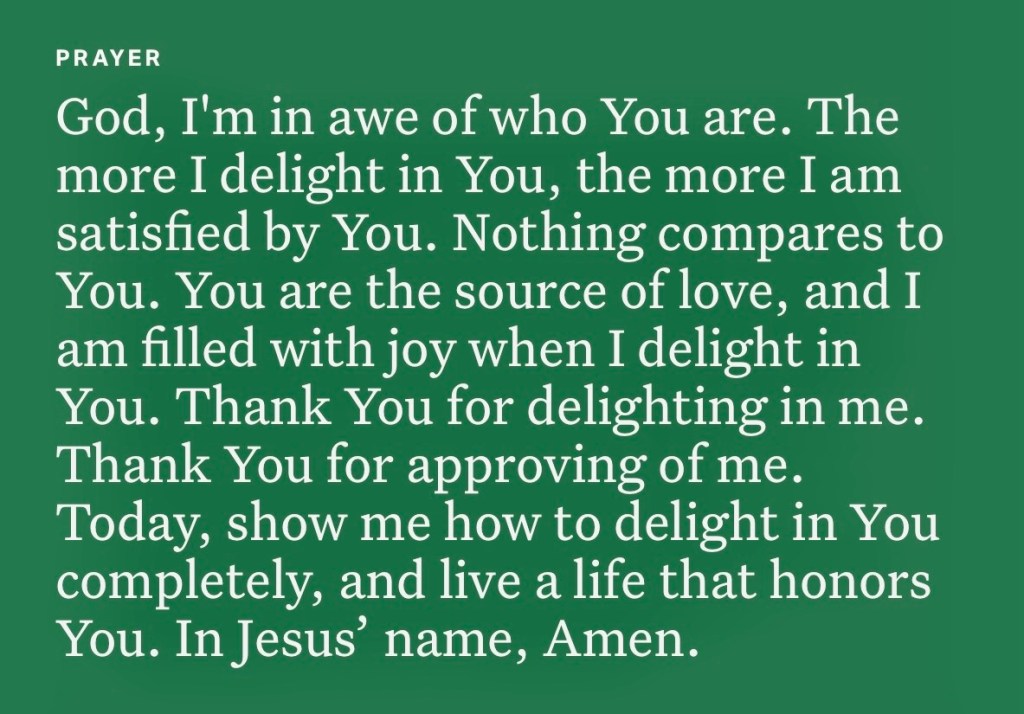
Understanding the Meaning of Delighting in the Lord*
To delight in the Lord signifies finding deep satisfaction, joy, and purpose in the presence and promises of God. This idea is woven through Scripture, from the praise-filled Psalms to the teachings of Jesus and the apostles. It involves an attitude of dependency on God’s character, revering Him as Creator and personal Redeemer. In this frame of mind, acts of worship, prayer, and obedience shift from obligations to joyful privileges, as hearts become anchored in His faithful love.
“Delight yourself in the LORD, and He will give you the desires of your heart.” (Psalm 37:4)
This well-known verse underscores an important principle: when one’s greatest pleasure is God Himself, His desires and ours begin to align, resulting in spiritual fulfillment and contentment.
Biblical Foundations of Delighting in God
Throughout Scripture, the call to delight in God appears repeatedly. In Psalm 1:2, the righteous person is described as one whose “delight is in the law of the LORD, and on His law he meditates day and night.” This portrait illustrates a continuous dwelling upon God’s truth, an ongoing posture of trust and reverence.
Elsewhere, Jesus articulates that those who remain in Him will “bear much fruit” (John 15:5). This fruit includes not only acts of love and service, but also the internal, joyous sense of belonging to the One who made and redeemed us. The New Testament consistently reaffirms that to know God, as He has revealed Himself, is to discover a wellspring of delight.
Aligning the Heart with God’s Word
Delighting in the Lord begins with savoring His word. Archaeological discoveries such as the Dead Sea Scrolls, unearthed in the mid-20th century near Qumran, show remarkable continuity between ancient manuscripts and modern Biblical texts. The faithfulness with which the Scriptures have been preserved affirms that the passages teaching believers to rejoice in God remain trustworthy. This historical reliability underscores the integrity of instructions such as Psalm 119:16: “I will delight in Your statutes; I will not forget Your word.”
From a practical standpoint, reading and reflecting on Scripture fosters transformation of both thought and disposition. In the realm of behavioral science, repeated focus on truth can shift one’s perspective, heightening peace, gratitude, and delight.
Embracing Prayer and Communion with God
Entering consistent, meaningful prayer shapes one to treasure the Lord more deeply. As Philippians 4:6-7 explains, bringing requests to God with thanksgiving leads to “the peace of God, which surpasses all understanding,” guarding hearts and minds. In such communion, the believer increasingly experiences God as a personal Father who listens, cares, and responds.
Woven through history are accounts of people whose prayer practices brought them fresh awareness of God’s presence. Anecdotal testimonies in every century, including those of early Christian writers, Reformation-era believers, and modern-day individuals, highlight an enduring pattern: when people cry out to God earnestly, they often find renewed joy and delight in Him.
Practicing Worship with Body, Mind, and Spirit
Worship in Scripture is not confined to singing-though the Psalms are a timeless testament to the power of music to lift hearts to God. It also includes dedicating work, relationships, and daily activities to the Lord. In Romans 12:1, believers are urged, “Offer your bodies as living sacrifices, holy and pleasing to God-this is your spiritual act of worship.”
In many cultures, corporate worship through song reinforces unity in delighting in the Lord. Historically, King David’s psalms were not only royal compositions but also living expressions of communal devotion. Artifacts and inscriptions discovered in areas such as the City of David point to structured gatherings where music and praise contributed to a collective delight in Yahweh. Modern worship likewise provides communal support, encouragement, and tangible reminders of God’s majesty.
Cultivating Obedience and Trust
To delight in the Lord means abiding trust, particularly in times of uncertainty. The Bible repeatedly displays individuals who chose obedience, trusting God’s promises even under dire circumstances. Abraham’s willingness to leave his homeland (Genesis 12) and Mary’s acceptance of the angel’s announcement (Luke 1) exemplify trusting God’s plan beyond one’s own understanding.
Geological and historical records that confirm biblical events-from the evidence of a global flood narrative in a variety of ancient cultures, to archaeological data such as the Ebla tablets referencing Semitic peoples-underscore the authenticity of accounts that shape our understanding of God’s engagement in history. When believers see that God has acted faithfully throughout time, obedience becomes a joyful, confident response every day.
Reflecting on God’s Character and Works
Meditating on who God is fuels deeper pleasure in Him. Reflecting on His work in creation-the consistent evidence of intelligent design seen in the vast complexity of DNA or the fine-tuning of universal constants-amplifies wonder at His magnificence. When one pauses to consider that the same God who orchestrated cosmic precision loves with a personal, redeeming love, it invigorates worship.
Similarly, recounting the resurrection of Christ as a historical event affirms that the One in whom we delight is the same God who raised Jesus from the dead in space and time. Such victories over death instill hope and confidence. This hope, confirmed by multiple lines of historical witness in the Gospels and letters, provides a deep wellspring of rejoicing.
Serving and Loving Others in His Name
Delighting in the Lord flourishes when believers extend God’s love to others. In Matthew 25:40, Jesus declares, “Whatever you did for one of the least of these brothers of Mine, you did for Me.” When Christians serve those in need, they tangibly express the joy found in relationship with Christ. This love in action further enriches one’s own delight in Him, fulfilling His command to “love one another” (John 13:34).
Practically, involvement in community service or faith-based outreach can enhance spiritual vitality. Many have attested to profound encounters with the Holy Spirit through caring for the poor, visiting the sick, or inviting those far from God to experience His grace.
Maintaining a Lifelong Perspective of Hope
The Psalmist’s repeated emphasis on remembering God’s past faithfulness fosters a pattern of hope for the future. This hope kindles delight, because it rests on God’s unchanging goodness. In the face of trials, believers return to the truth that God’s promises stand. Romans 8:38-39 affirms that nothing “will be able to separate us from the love of God that is in Christ Jesus our Lord.”
When doubts arise, many find strength by examining the consistent internal harmony of Scripture, supported by thousands of manuscripts spanning centuries. Similarly, archaeological findings such as the Tel Dan Stele-which corroborates the historical presence of the House of David-reinforce the reliability of biblical narratives. Such evidence reinforces a worldview in which one can securely delight in the everlasting God.
Practical Steps to Daily Delight
1. Spend time consistently in Scripture, reflecting prayerfully on passages that emphasize God’s love, sovereignty, and faithfulness.
2. Engage in regular prayer, both communal and personal, offering thanksgiving as well as requests and confessions.
3. Incorporate worship music, psalms, and hymns into daily routines. Singing truth can recalibrate the heart toward God’s greatness.
4. Serve within your local community, reflecting God’s compassion.
5. Surround yourself with fellow believers who encourage growth in faith and joy.
6. Keep a journal of answered prayers and personal encounters with God to remember His works in your life.
Conclusion
Delighting in the Lord is an invitation to place full confidence in the only One deserving of complete trust. By meditating on Scripture, praying, worshiping, and reflecting on His faithfulness through history, believers can experience genuine joy rooted in a life-giving relationship with God. As Psalm 16:11 proclaims, “You have made known to me the path of life; You will fill me with joy in Your presence, with eternal pleasures at Your right hand.” This assured promise stands as a lasting source of delight for any who seek Him wholeheartedly
I am marking this post to save and to read over and over again. I don’t know about you, but I need to remind myself of God’s presence and the pleasures that I find there. Life and its trials sometimes get in the way of my encounters with God, but in this season of testing, I am finding that pressing in is the way up and out. Today is Thankful Thursday for me, so here is a partial list of what I am thankful for today. (Partial because I will continue to add to the list as the day progresses.)
~For rest and a new day
~For each breath I take and every fresh scent I have smelled today, especially the tea I made to start the day
~For the cloudy day that reminds me that the sun is just behind the clouds
~For the rain that is soaking Harry’s garden and will produce a nice crop of peas for us
~For the photo frames all around me that remind me of the blessings of having children and grandchildren
~For having books to read and friends to talk to about them
~For my husband who made egg salad for my lunch today
~For fresh water to drink
~For a good report from my nephrologist
~For the love of the Lord who shows me every day how precious I am to Him
~For the birds outside my window who are enjoying the birdseed my husband replenished yesterday
~For hot water for my shower
~For less pain in my right shoulder and for my left arm that is able to work properly
~For friends in our Bible study group who pray for each other and check in on each other
~For a sweet granddaughter who is living with us and keeping us company
~For authors who trust me with their new book babies
~For praise music on my device that I can listen to anytime
~For online friends on WordPress who encourage me and make me ponder
There are an endless number of things to be thankful for today and everyday! Please join me in Thankful Thursday and add a comment about what you are thankful for today.













 Vickie's Book Nook and Meditation Corner