I am a Christian, a retired teacher, a mother and a grandmother. I love to read and I love the Lord Jesus Christ! Unless otherwise specified ,all visual illustrations are from the YOU VERSION APP of the Bible.
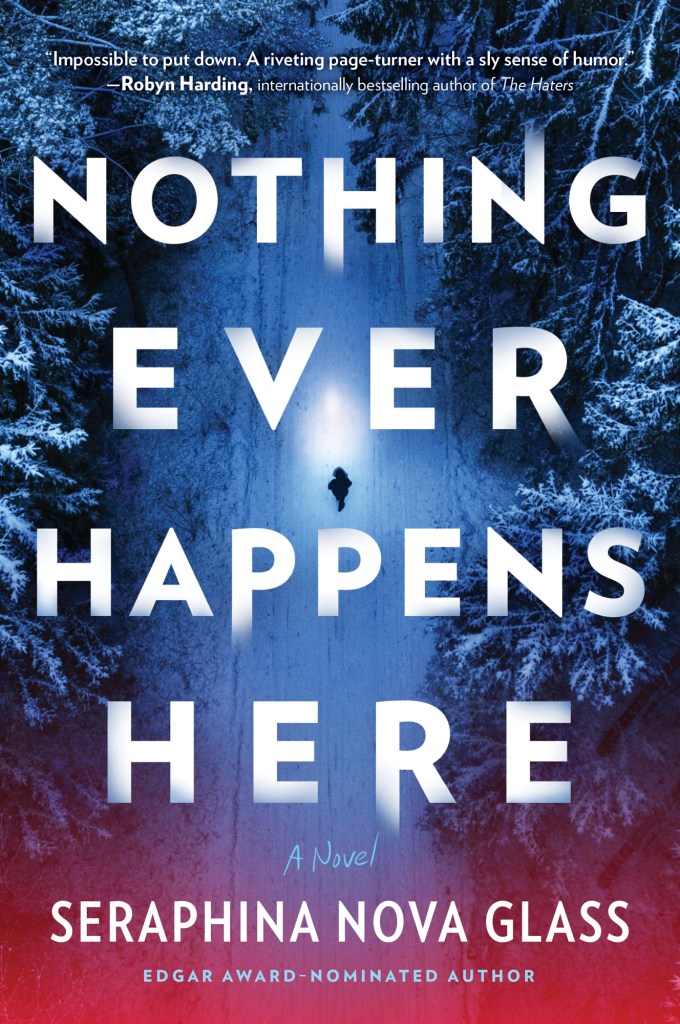
“A charming cast of characters, a twisty mystery, and a diabolical killer make Nothing Ever Happens Here impossible to put down. A riveting page-turner with a sly sense of humor.” —Robyn Harding, internationally bestselling author of The Haters
Nothing ever happens in small towns…
When Shelby Dawson survives a harrowing attack that should have left her dead, she tries to move past it—for herself, and for her family. Fifteen months later, with the help of her best friend, Mackenzie, she finally feels safe again in the snowy Minnesota town she calls home. But when an anonymous note appears on her windshield bearing the same threats her attacker made, Shelby realizes that her nightmare has only just begun.
As new evidence surfaces, and a group of well-meaning senior citizens accidentally makes the case go viral online, the situation quickly goes from bad to worse. And with suspicious accidents targeting those closest to her happening all over town, Shelby can’t shake the feeling that she’s being watched. Fighting to stay one step ahead of disaster, she finds herself asking the question on everyone’s lips: Who attacked her that night?
But Shelby isn’t the only one with questions. Mackenzie’s husband, Leo, vanished without a trace on that terrible night, and over a year later, no one knows why. Until a deep dive into his finances reveals a history of debts, mismanaged funds, and hidden accounts—one of which is still active. Their suspicion that Leo is still alive only complicates things further, though, and when another person connected to Shelby goes missing, she’s caught in a race against time before her attacker becomes a killer.
My Thoughts
This novel is like a roller coaster ride going around curves and downhill the entire time. The twists just keep coming and kept me guessing as a small town is faced with disappearances, money laundering and even a possible murder. Two friends, Mackenzie and Shelby, both face unimaginable crises. Mack’s husband is missing and Shelby is attacked the same night that Leo disappears. There are so many creative and original page-turning and head-spinning twists that I cannot explain without giving away too much of the plot, but suffice it to say that the story was engaging, fast-moving and written with an edge that kept me reading. There is also the comic relief provided by the elderly residents of Oleander, a residence operated by Shelby. These residents are smart and protective of Shelby and want to help solve the crimes going on around town but end up getting themselves in trouble for their efforts. I really enjoyed the characterization because it was spot on fascinating and totally realistic. The elderly were quirky, Shelby was terrified and Mack was understandably frantic about her missing husband and her financial situation. Even the secondary characters like the Shelby’s children and husband Clay were believable and authentically portrayed. I enjoyed the story with its intense suspense sprinkled into the drama of the friends. With a complex plot and a mystery to try to solve, the author did a fantastic job of pulling me into the story and not letting to until the satisfying ending. This would be a great book to discuss in a book group since the characters are so varied and the plot is so memorable. Disclaimer I received a complimentary copy of this book from the publisher via Netgalley. I was not required to write a positive review, and all opinions expressed are my own.
Contemporary Fiction, General Fiction, Rated PG-16
About the Author
Seraphina Nova Glass is an assistant professor of instruction and playwright in residence at the University of Texas, Arlington, where she teaches film studies and playwriting. Her novel On A Quiet Street was nominated for an Edgar Award, was a New York Times Summer Read, an Amazon Bestseller and Editor’s Pick, and also featured in the Boston Globe and Bustle. Publishers Weekly has named her “a writer to watch.” She’s also an award-winning playwright and holds an MFA degree in dramatic writing from Smith College and a second MFA in directing from the University of Idaho. She is a proud dog mom and loves to travel the world with her husband. She resides in Dallas, Texas.
“A fast-paced and vibrant wartime tale of holding on to love against the odds and learning to fight for the truth.” –Kristin Harmel, New York Times bestselling author of The Paris Daughter
A Parisian department store, a mysterious necklace and a woman’s quest to unlock a decade-old mystery are at the center of this riveting novel of love and survival, from New York Times bestselling author Pam Jenoff
London, 1953. Louise is still adjusting to her postwar role as a housewife when she discovers a necklace in a box at a secondhand shop. The box is marked with the name of a department store in Paris, and she is certain she has seen the necklace before worked with the Red Cross in Nazi-occupied Europe —and that it holds the key to the mysterious death of her friend Franny during the war.
Following the trail of clues to Paris, Louise seeks help from her former boss Ian, with whom she shares a romantic history. The necklace leads them to discover the dark history of Lévitan—a once-glamorous department store that served as a Nazi prison, and Helaine, a woman who was imprisoned there, torn apart from her husband when the Germans invaded France.
Louise races to find the connection between the necklace, the department store and Franny’s death. But nothing is as it seems, and there are forces determined to keep the truth buried forever. Inspired by the true story of Lévitan, Last Twilight in Paris is both a gripping mystery and an unforgettable story about sacrifice, resistance and the power of love to transcend in even the darkest hours.
My Thoughts
This historical fiction novel includes a multi-layered plot, mesmerizing and realistic characters, dual timelines and two different points of view. The timelines are close together, in the 40’s during the war and in the 50’s following the war and I found this a unique perspective from most historical fiction. One narrator is Helaine, a Jew in Paris who is captured and forced to work in a former upscale department store. There she has to sort and sell things that the Nazis have confiscated from the Jewish people they have sent to prison camps. The second narrator is Louise, a housewife in London who finds a necklace that she saw on the day a good friend died during the war. Louise is determined to go on a quest to find the other half of the necklace and to find out what really happened the night that Franny died. There are a lot of characters, a great deal of history and a completely absorbing plot as Louise follows the clues to a resolution and Helaine’s story of forced labor and being away from her beloved husband are told. I enjoyed the details of the story, especially the way the layers dovetailed together seamlessly at the conclusion. I also liked meeting the characters who were realistically flawed, with love lives that were not perfect and their dreams that they tried to fulfill. This is a timeless story of persistence, friendship, loyalty and tragedy that is memorable and a great book for discussion. Disclaimer Disclosure of Material Connection: I received a complimentary copy of this book from the publisher via Netgalley. I was not required to write a positive review, and all opinions expressed are my own. (Federal Trade Commission’s 16th CFR, Part 255, “Guidelines Concerning the Use of Testimonials and Endorsements in Advertising.”)
Historical Fiction with content about treatment of war prisoners, Rated PG
About the Author
Pam Jenoff is the author of several books of historical fiction, including the NYT bestseller The Orphan’s Tale. She holds a degree in international affairs from George Washington University and a degree in history from Cambridge, and she received her JD from UPenn. Her novels are inspired by her experiences working at the Pentagon and as a diplomat for the State Department handling Holocaust issues in Poland. She lives with her husband and 3 children near Philadelphia, where she teaches law.
Helaine stumbled forward, unable to see through the black void that surrounded her. She could feel the shoulders of the others jostling on either side. The smell of unwashed bodies rose, mingling with Helaine’s own. Her hand brushed against a rough wall, scraping her knuckles. Someone ahead tripped and yelped.
Hours earlier, when Helaine had been brought from her underground cell at the police station into the adjacent holding area, she was surprised to see other women waiting. She had not encountered anyone since her arrest. She had studied the women, who looked to be from all walks of life, trying to discern some commonality among their varied ages and classes that had caused them to be here. There was only one: they were Jews. The yellow star they wore, whether soiled and crudely sewn onto a worn, secondhand dress or pressed crisply against the latest Parisian finery, was identical—and it made them all the same.
They had stood in the bare holding area, not daring to speak. Helaine was certain that her arrest had been some sort of mis take. She had done nothing wrong. They had to free her. But even as she thought this, she knew that the old world of being a French citizen with rights was long gone.
An hour passed, then two. There was nowhere to sit, and a few people dropped to the floor. An elderly woman dozed against the wall, mouth agape. But for the slight rise and fall of her chest, she might have been dead. Hunger gnawed at Helaine and she wished that she still had the baked goods she purchased at the market just before she was taken. The meager breads, which had seemed so pathetic days earlier, now would have been a feast. But her belongings had been confiscated at arrest.
Helaine looked upward through the thin slit of window near the ceiling. They were still in Paris. The sour smell from the city street and the sounds of cars and footsteps despite the curfew were familiar, if not comforting. How long they would stay here, she did not know. Helaine was torn. She did not want to remain in this empty room forever. Yet she also dreaded leaving, for wherever they were going would surely be worse.
Finally, the door had opened. “Sortir!” a voice ordered them out in native French, reminding Helaine that the policemen, who had brought them here and who were keeping them captive, were not Germans, but their own people.
Helaine had filed into the dimly lit corridor with the others. They exited the police station and stepped outside onto the pavement. At the sight of the familiar buildings and the street leading away from the station, Helaine momentarily considered fleeing. She had no idea, though, where she would go. She imagined running to her childhood home, debated whether her estranged mother would take her in or turn her away. But the women were heavily guarded and there was no real possibility of escape. Instead, Helaine breathed the fresh air in great gulps, sensing that she might not be in the open again for quite some time.
The women were herded up a ramp toward an awaiting truck. Helaine recoiled. They were being placed in the back part of the vehicle where goods should have been carried, not people. Helaine wanted to protest but did not dare. Smells of stale grain and rotting meat, the truck’s previous cargo, assaulted her nose, mixing with her own stench in the warm air. It had been three days since she had bathed or changed and her dress was wrinkled and filthy, her once-luminous black curls dull and matted against her head.
When the women were all inside the truck, the back hatch shut with an ominous click. “Where are they taking us?” someone whispered. Silence. No one knew and they were all too afraid to venture a guess. They had heard the stories of the trains headed east to awful places from which no one ever returned. Helaine wondered how long the journey would be.
As they bumped along the Paris streets, Helaine’s bones, already sore from sleeping on the hard prison cell floor, cried out in pain. Her mouth was dry and her stomach empty. She wanted water and a meal, a hot bath. She wanted home.
If home was a place that even existed anymore. Helaine’s husband, Gabriel, was missing in Germany, his fate unknown. She had scarcely spoken with her parents since before the war. And Helaine herself had been taken without notice. Nobody knew that she had been arrested or had any idea where she had gone. It was as if she simply no longer existed.
To distract herself, Helaine tried to picture the route they were taking outside the windowless truck, down the boulevards she had just days earlier walked freely, past the cafés and shops. The familiar locations should have been some small comfort. But this might well be the last time she ever came this way, Helaine realized, and the thought only worsened her despair.
Several minutes later, the truck stopped with a screech. They were at a train station, Helaine guessed. The back hatch to the truck opened and the women peered out into pitch blackness. “Raus!” a voice commanded. That they were under the watch of Germans now seemed to confirm Helaine’s worst fears about where they were headed. “Schnell!” Someone let out a cry, a mix of the anguish and uncertainty they all felt.
The women clambered from the truck and Helaine stumbled, banging her knee and yelping. “Quiet,” a woman’s voice beside her cautioned fearfully. A hand reached out and helped her down the ramp with an unexpectedly gentle touch.
Outside the truck it was the tiniest bit lighter, and Helaine was just able to make out some sort of loading dock. The group moved forward into a large building.
Now Helaine found herself in complete darkness once more. This was how she had come to be in an unfamiliar building, shuffling forward blindly with a group of women she did not know, uncertain of where they were going or the fate that might befall them. She could see nothing, only feel the fear and confusion in the air around her. They seemed to be in some sort of corridor, pressed even more closely together than they had been. Helaine put her hand on the shoulder of the woman in front of her, trying hard not to fall again.
They were herded roughly through a doorway, into a room that was also unlit. No one moved or spoke. Helaine had heard rumors of mass executions, groups of people gassed or simply shot. The Germans might do that to them now. Her skin prickled. She thought of those she loved most, Gabriel and, despite everything that had happened, her parents. Helaine wanted their faces, not fear, to be her final thought.
Bright lights turned on suddenly, illuminating the space around them. “Mon Dieu!” someone behind her exclaimed softly. Helaine blinked her eyes, scarcely daring to believe what she saw. They were not in a camp or a prison at all. Instead, they were standing in the main showroom of what had once been one of the grandest department stores in Paris.



 Vickie's Book Nook and Meditation Corner